Knockout Pressure Points: Are They Real Or Fake? We Explore!
Contents
- What Are Pressure Points?
- What Happens When You Use Pressure Points In Martial Arts?
- Striking
- Compression
- What Is Pressure Point Fighting?
- How Do I Use Knockout Pressure Points
- Are There Myths Around Pressure Point Fighting?
- Watch This!
- Frequently Asked Questions
- How Can I Practice Pressure Point Fighting?
- Are Knockout Pressure Points Dangerous?
- How Are Pressure Points Used in Medicine?
- Conclusion
- Sources
If you watch martial arts movies, you've probably seen a fighter drop an enemy with a single touch.
Some of them even show that you can kill someone with a touch of a finger!
These techniques are tied to so-called "pressure points." But can a person really be knocked out, let alone killed, that way?
We'll look at what pressure points are, what actually happens when vulnerable areas are struck, and the myths around pressure point fighting. Read on!
What Are Pressure Points?
In martial arts, a pressure point is a sensitive spot on the body, usually where nerves, blood vessels, tendons or joints sit close to the surface.
Traditional Chinese medicine maps hundreds of acupuncture points on the body.
The idea comes mainly from Asian traditions, especially in China and India. These points have been used both in healing, as in acupuncture, and in martial arts.
Nobody knows exactly when pressure point striking entered the martial arts, but it is linked to Asian fighting traditions.
Many styles teach pressure points, including karate, kung fu, and the South Indian art Varma Kalai. Kyusho Jitsu focuses on them most. According to Kyusho Jitsu UK, it is "a way of attacking the nervous system to control an attacker or subdue an attacker to maintain your advantage and stay in control."
Let's look at what happens when these areas are targeted.
What Happens When You Use Pressure Points In Martial Arts?
Of all the pressure points described in the body, martial artists focus on only a few. Many are around the joints, such as the knees, elbows and neck.
The effect depends on where the point is and how it's attacked:
Striking
A strike is a direct blow. A hard strike to a sensitive area may cause:
- Sharp pain
- A stunning effect
- Disorientation or loss of balance
- A reflex response
- Numbness or weakness in the affected area
Compression
You can also press or squeeze a sensitive area rather than strike it, as in holds and chokes. The person may experience:
- Disorientation or loss of balance
- Numbness or weakness in the affected area
- Muscle spasms
- Unconsciousness, in the case of chokes that cut off blood flow to the brain
What Is Pressure Point Fighting?
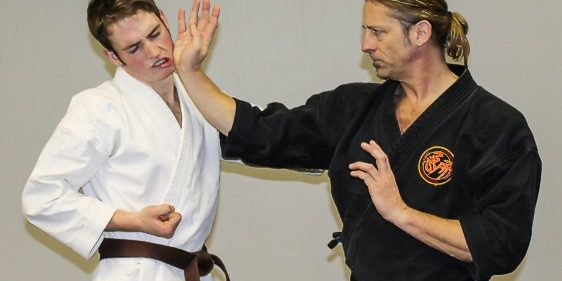
As the name suggests, it's a way of fighting that targets sensitive areas of the body. How each area is attacked changes the effect on the opponent. It is usually taught as part of self-defense.
Instructors often describe three types:
- Pain compliance pressure point fighting - the use of pain or discomfort to gain a compliant response from a non-compliant person
- Impact pressure point fighting - the use of limbs or a blunt weapon (like a stick or club) to directly strike an opponent
- Blood flow pressure point fighting - the use of specific techniques (like chokes and holds) to reduce blood flow to the brain
You may be asking, "Can these techniques really knock someone out?"
"Knockout" means different things to different martial artists. Some use it for a brief daze, others for a fall to the ground, and others for actual loss of consciousness.
Of the three types above, only impact and blood-flow techniques can cause unconsciousness. Both are dangerous.
A hard blow to the head can cause a concussion, which the CDC describes as a traumatic brain injury caused by a bump, blow or jolt to the head. A knockout is a brain injury, not a harmless "off switch."
Chokes that cut off blood flow to the brain can cause unconsciousness within seconds. In sport, they are applied under a referee's watch and released immediately. In a street fight, holding a choke too long can cause brain damage or death.
Self-defense is about getting away safely. Most laws only allow force that is reasonable and proportionate to the threat, so the goal is to escape, not to injure.
How Do I Use Knockout Pressure Points
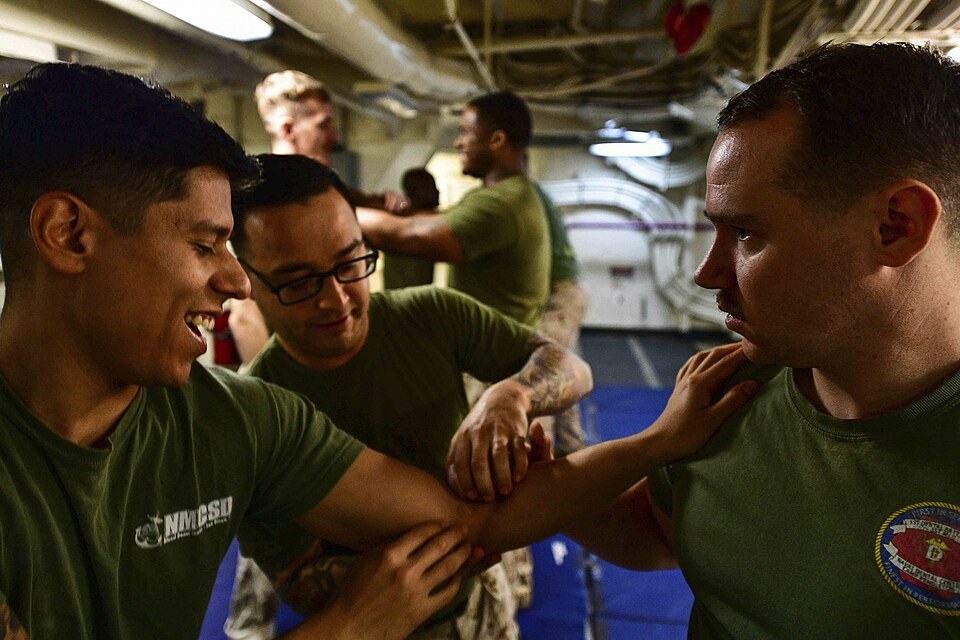
Photo by Commander, U.S. Naval Forces Europe-Africa/U.S. 6th Fleet, Public domain, via Wikimedia Commons
Knockout Pressure Points
These are the areas most often taught in self-defense, from head to toe. Several are dangerous enough that a hard strike can cause serious injury or death, so treat them as a last resort for escaping a real attack:
- Temple
- The temple is on the side of the head, behind and above the eye. The skull is thin here, and an artery runs just underneath.
- A hard blow to the temple can cause bleeding inside the skull, which is a medical emergency. This is a dangerous target, not a sparring target.
- Eyes
- A jab or rake toward the eyes can stop an attacker long enough for you to escape.
- As they cover their eyes, use the moment to get away. Eye injuries can be permanent, so only consider this when you're in real danger.
- Ears
- A slap to the ear can stun an attacker and cause significant pain, and it can rupture the eardrum.
- Nose
- The nose is mostly cartilage and breaks easily. A strike to the nose is very painful and makes the eyes water, though it rarely causes unconsciousness.
- Strikes to the nose can be used to create space to escape.
- Chin
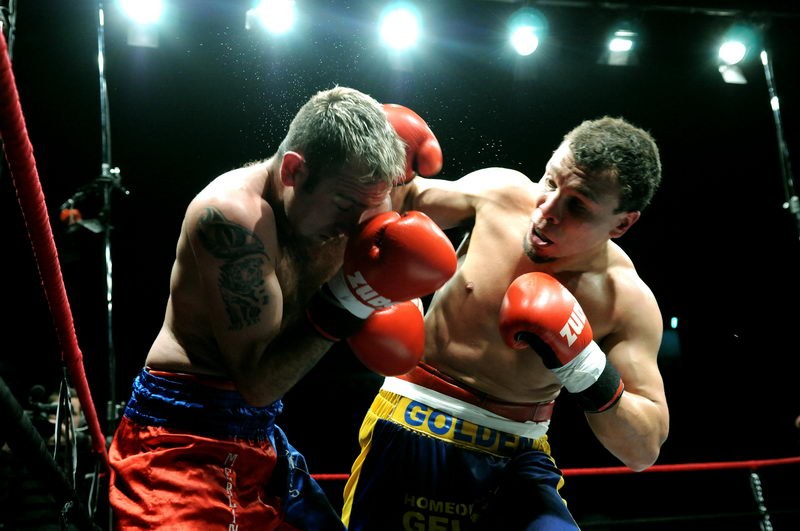
- A strike to the chin or jaw snaps the head around, which is why so many knockouts in boxing come from jaw shots. That is also why it carries a concussion risk.
- Nape
- The nape is the back of the neck, where the upper spine meets the skull.
- Strikes here are banned in combat sports because they can injure the spine and brainstem. Don't use them in training or in sparring.
- Throat
- The throat holds the windpipe and the major blood vessels to the brain.
- Strikes and pressure here can crush the windpipe or injure the carotid arteries, which can be fatal. They are banned in every combat sport and are not appropriate self-defense targets unless your life is at risk.
- Abdomen
- The abdomen has several sensitive targets.
- The solar plexus sits in the upper abdomen, just below the bottom of the breastbone.
- A blow there can knock the wind out of someone, causing pain and short-term difficulty breathing.
- Strikes to the sides or stomach can also hurt, since the abdomen has little bony protection over its organs.
- Finally, a kick or knee to the groin is a classic way to stop an attacker, especially a male one, and give you time to run.
- Arms
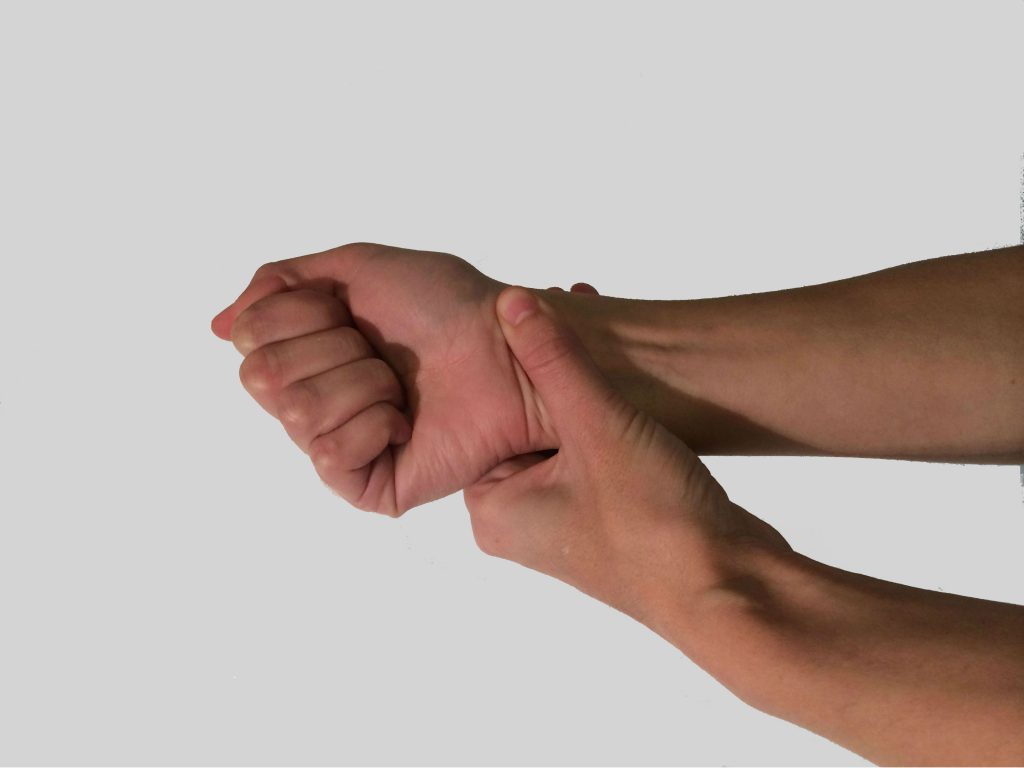
- If an attacker is armed, self-defense courses teach wrist controls that bend the wrist to loosen the grip on the weapon.
- These techniques take a lot of practice with a qualified instructor and are risky against a real weapon. Escape is always the first choice.
- Legs
- A kick to the side or back of the knee can buckle an attacker's leg. A kick to the side of the knee can tear ligaments.
- Kicks to the shin or a stomp on the foot can also help you break free, especially if they are pulling you to the ground.
Are There Myths Around Pressure Point Fighting?
Movies, TV shows and pop culture exaggerate pressure point fighting. This is especially true of dim mak (or death touch), which claims you can kill someone with a light touch on a specific point. There is no scientific evidence that it works.
In practice, pressure point fighting has limited use in a real fight.
When you're fighting, both you and your opponent are moving and trying not to get hit. Hitting a small, specific point under that pressure takes great accuracy.
A light touch on a pressure point won't cause paralysis or death, as dim mak claims. The real dangers come from hard blows to vulnerable areas such as the head and neck.
That's why pressure point tricks that look impressive on a cooperative partner often fail against a resisting opponent. The chances of pulling them off in a real fight are low.
You can train martial arts without focusing on pressure points at all. Your time may be better spent on accuracy, conditioning and live sparring.
Knock-Out Point: Having knowledge of pressure points is good but quite impotent without a power punch to back it up! We have written a post shedding light on how much force is behind a person's punch -- Average Human Punch Force.
Watch This!
Frequently Asked Questions
How Can I Practice Pressure Point Fighting?
Learn it from a qualified instructor in a supervised class. Practice slowly and lightly with a cooperative partner, and never strike the head, neck or throat in training.
Are Knockout Pressure Points Dangerous?
Yes. Many of these areas are vulnerable because they protect vital structures, and strikes to them can cause severe injury or death.
A blow to the head can cause bleeding around the brain, such as a subdural hematoma, which is an emergency. Damage to the eyes can be permanent, and injury to the throat or carotid artery can kill. If you train with a partner, go slowly, use control and stay away from the head and neck.
How Are Pressure Points Used in Medicine?
In traditional Chinese medicine, these points are used in acupuncture and acupressure. According to the NIH, acupuncture may help several pain conditions, such as back, neck and knee pain, though the evidence is mixed for many other uses.
Conclusion
The body has vulnerable areas, but movie-style pressure point knockouts are a myth. Real knockouts come from hard blows to the head or from chokes, and both can cause serious injury.
In a self-defense situation, your best tools are awareness, distance, simple strikes to create space, and getting away. Train with a qualified instructor and treat these targets with respect.
Sources
- Acupuncture: What You Need To Know, National Center for Complementary and Integrative Health
- About Mild TBI and Concussion, Centers for Disease Control and Prevention
- Subdural hematoma, MedlinePlus